
Ready to explore how Italians talk about feelings?
Here you can try a word search focused on stati d’animo, the words Italians use to describe moods and emotions.
Solve the puzzle, listen to how the words sound, and see them used in real Italian sentences.
Let’s play and learn! 🎯
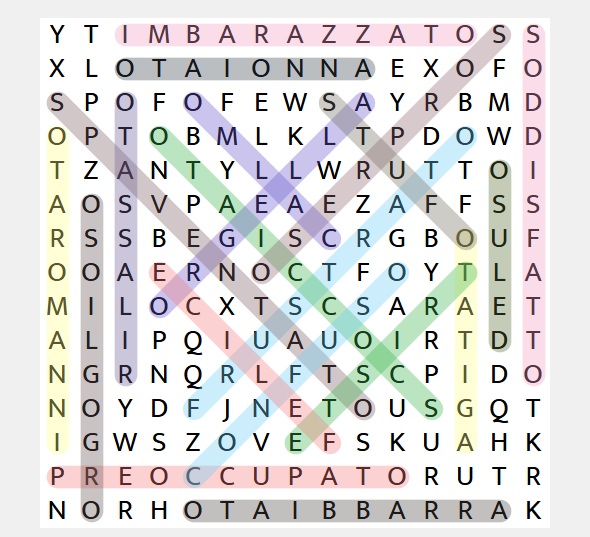
In this word search, you’ll find Italian adjectives used to describe moods and emotions.
To play, simply highlight each hidden word by dragging your mouse or finger across the letters — from the first to the last.
It’s a simple, effective way to expand your vocabulary and recognise how Italians describe how they feel in everyday situations
Once you’ve solved the puzzle, scroll down to see the full list of words with their English translations, you can click on each Italian word to hear how it sounds.
Then, for some extra practice, explore the “Parole in contesto” section to see how these words are used in everyday Italian sentences.
Finally, if you get stuck, you’ll find the solution at the bottom of this puzzle.
Here’s the full list of Italian adjectives from this puzzle, along with their English meanings.
Click or tap on each Italian word to hear how it’s pronounced, it’s my own voice, not AI! 🎧
Here you’ll find all the adjectives used in real Italian sentences, a great way to see these words in action!
If you’re unsure of the meaning, just click or tap to reveal the English translation.
In Italian, there's a subtle difference between "Come va?" (How's it going?) and "Come stai?" (How are you?). While "Come va?" might get a quick "Tutto a posto" (All good), asking "Come stai?" often invites a more genuine response.
When I first moved to the UK, I used to reply honestly when people asked “How are you?”. I might say I was a bit stressed at work, or worried about money. When they looked mildly surprised, I’d carry on explaining. I eventually learned that “Fine, thanks!” was the expected response. But where’s the fun in that?
In Italian, it’s completely normal to use words like preoccupato, stufo, soddisfatto, or deluso in everyday conversations. Talking about how you feel is part of normal social interaction, not something reserved for close friends.